Grassroots women entrepreneurs across Africa are already contributing to climate action in their communities, from sustainable agriculture and clean energy to waste management and the circular economy. Yet much of this work remains invisible to the institutions that shape finance, policy and development support. The solution to this challenge is not more data, but rather ensuring that it reaches relevant decision makers.
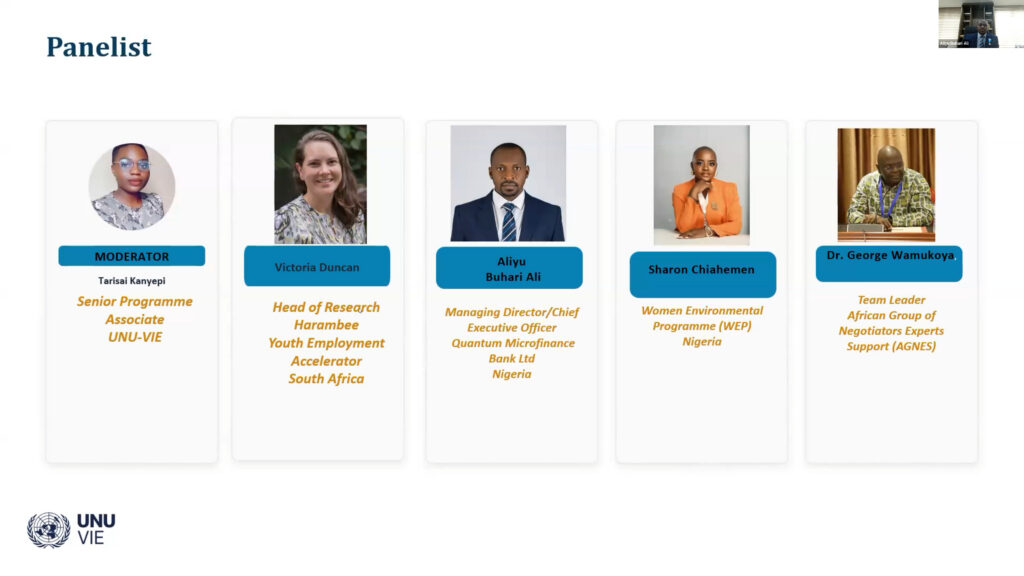
This was one of the key insights from the second webinar of Greenovations Africa 2, “Quantifying the Invisible: Centering Grassroots Women Green Entrepreneurs in Climate Finance and Policy”, held on 10 August 2026. The webinar brought together the Women Environmental Programme (Nigeria), Harambee Youth Employment Accelerator (South Africa), Quantum Microfinance Bank (Nigeria), African Group of Negotiators Experts Support (AGNES) and grassroots entrepreneurship networks from Zambia to discuss how better evidence can strengthen recognition, inform policy and improve access to climate finance for grassroots women-led green enterprises.
The conversation started with an important distinction: the problem is not that grassroots women are not taking climate action. Rather, much of their impact is not documented in ways that financial institutions, policymakers and support organisations can readily use. Their evidence is often fragmented, inconsistent or simply missing from the systems where decisions are made.
Against this backdrop, the webinar introduced the Green Entrepreneurs Climate Impact Measurement (GECIM) tool, which brings together evidence on business performance, climate contribution, gender and unpaid care, enterprise readiness and support needs. The ensuing discussion focused on how this crucial information could become useful to the different institutions that make decisions affecting grassroots women entrepreneurs.
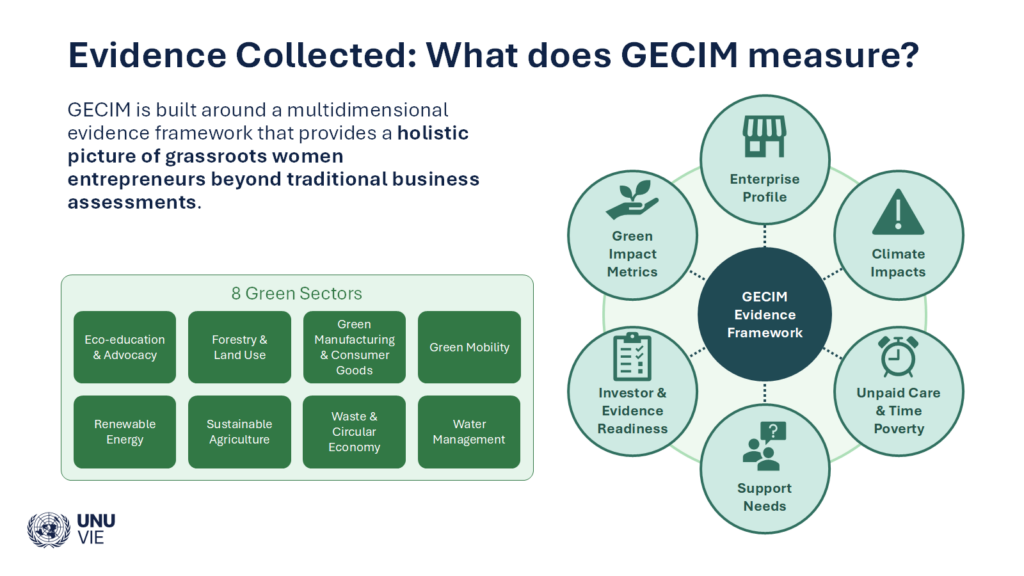
For financial institutions, this means having clearer information on how a business operates, its income and cash flow, how much financing is needed and whether that financing can realistically be repaid. For policymakers, it means evidence that can speak to national climate planning while still reflecting differences between countries and communities. Organisations working directly with women saw value in combining numbers with women’s own experiences, particularly where highly technical climate data may be difficult to provide.
One part of the conversation that stood out was unpaid care work. Time spent on childcare, eldercare and household responsibilities affects the time women can devote to their businesses and, ultimately, their ability to grow them. However, the discussion showed that care cannot be looked at on its own it intersects with transport, safety, access to finance and other everyday realities.
There was also a clear message that standardization should not mean one-size-fits-all. While a common framework could save women from repeatedly providing similar information to different organisations, it must still be flexible enough to reflect different national and local contexts. Panellists further highlighted the need to better account for women with disabilities and to connect the evidence generated through GECIM with existing national statistics, care and green-economy frameworks.
Lastly, the webinar sparked a practical connection beyond the discussion itself, with participants from Zambia and Nigeria expressing interest in exchanging experiences on cooperative models for informal sector entrepreneurs.
Perhaps the clearest takeaway from the conversation was that visibility is not simply about collecting more data. What matters is whether that evidence can travel from grassroots women and their businesses to the institutions that make decisions. That is where the potential of GECIM lies: creating a stronger bridge between climate action already happening on the ground and the finance, policy and support systems that can help it grow.